

You know my love for Japan, its printed fabrics, its beautiful clothes, its traditions... but do you know about furoshiki?
These are starting to be popular in so-called "zero waste" sewing, and you’re beginning to see them in some specialty stores.

Furoshiki made of national drache fabric - www.cestdujoly.be
Let me explain. The furoshiki technique consists of folding and tying a square of fabric to wrap and carry objects in a practical but also very aesthetic way.
Today, this technique is used to replace gift wrap and plastic bags. The furoshiki fabric square can be recycled by the gift recipient or reused instead of throwing gift wrap in the trash.
It also proves very useful as an extra bag for shopping or for carrying items (e.g., a pie for a picnic, books...).
What’s nice is that once the items are set down, you just fold the furoshiki back into your bag instead of carrying around an empty rigid reusable bag.
For a bit of history, in Japan, the furoshiki was intended for transport but especially for protecting valuable items like kimono-type clothing.
Later, this square of fabric was used to pack bath items for going to the public bath. It could also be used for drying off. While fewer furoshiki are seen at public baths today, there is a renewed interest in this traditional method in Japan.
Indeed, the ecological awareness of the Japanese and the Ministry of the Environment are trying to bring it back into fashion to reduce plastic bag consumption.
Instead of taking a plastic bag for each purchase, you could slip your furoshiki into your bag, which will become very useful for carrying your purchases.

There are many folding techniques that allow you to carry objects of different sizes and shapes.
Whether it’s a square box, a sphere, a cylinder, bottles... there is a folding/tying technique associated to ensure safe transport.
Here are a few examples:
Today, you can find furoshiki made of silk, cotton, viscose... often decorated with traditional patterns or in shibori (a characteristic blue dye) or chirimen (crepe woven with a raised ripple effect). However, more contemporary designs are starting to appear to appeal to younger generations.
Even today, the Japanese pay close attention to the choice of colors and patterns of the furoshiki used to wrap a gift.
Indeed, these two parameters will vary depending on the occasion, the season, and the person receiving the gift. Shades like red, gold, light green, and light blue are intended for happy events, while darker tones are more appropriate for sad events, where bright colors should be avoided.
Purple is a symbol of longevity; it can be used for any occasion.
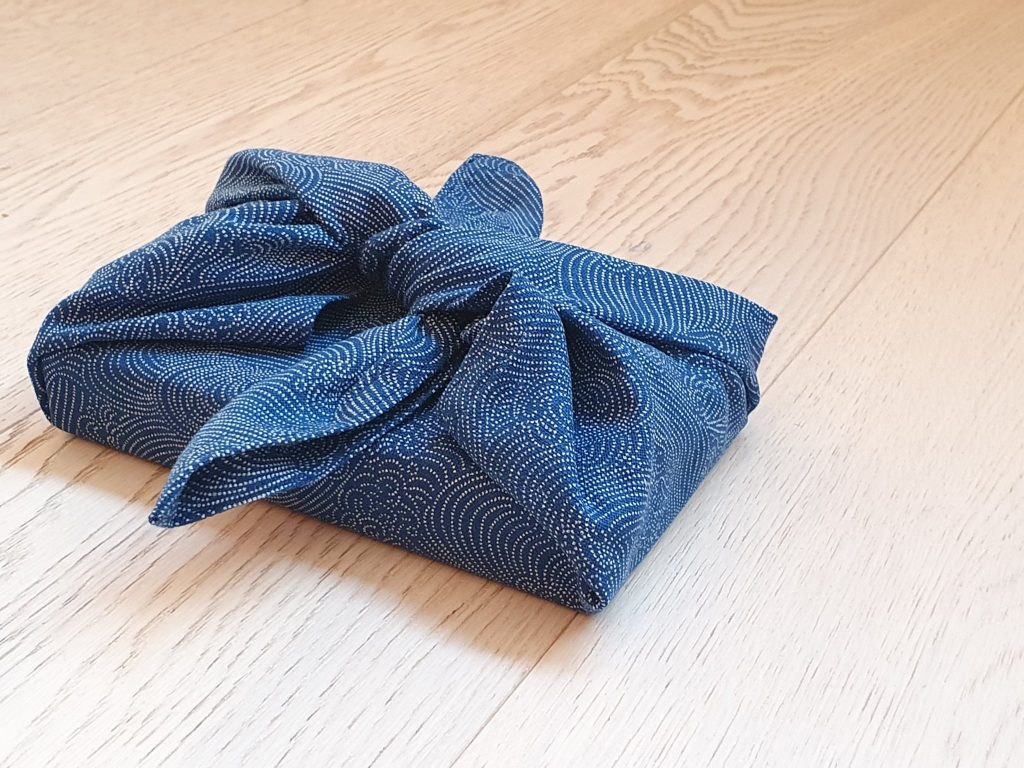 furoshiki in Nami fabric - www.cestdujoly.be
- the cherry blossom, sakura, in spring,
- the maple leaf, momiji, in autumn,
- the plum blossom, ume; the pine, matsu; the bamboo, take; the waves, seigaiha, symbols of good omen,
- the arabesque pattern, karakusa, associated with green symbolizing happiness,
- the chrysanthemum, kiku, symbol of virtue and longevity,
- the peony, botan, symbol of nobility.

Chrysanthemum/Kiku - www.cestdujoly.be
- the rabbit, usagi, a good luck charm, often combined with autumn plants and the full moon,
- the crane, tsuru, represents victory and brings good news (a suitable motif for births and weddings),
- the shell, kai-awase, symbol of marital fidelity
Its shape is currently most often square. The size of the furoshiki varies depending on the intended use:
- 45 cm square: to wrap money (holiday or funeral period),
- 50 or 52 cm square: to carry a bento box or wrap small gifts like a pocket book, a perfume package...
- 68, 70 or 75 cm square: to wrap larger gifts
- 90 cm square: to wrap a bottle, an A4-sized book, or make a small bag to hold several small items,
- 105 or 118 cm square: the most versatile for making bags,
- 128 or 140 cm square: to wrap clothes or make a large picnic basket,
- 150 cm square: for transporting or wrapping a bulky object,
- 175 or 195 or 230 cm square: to carry futons and duvets, for example, for a move.

To make furoshiki, you can of course buy fabric but also reuse scraps, old sheets (which can be re-dyed), or find second-hand textiles... to extend the zero waste approach.
I decided to sell some in my shop to offer, to those who don’t know how to sew, pretty furoshiki in current colors.
