


The spool of thread... an essential for all sewing projects. Whether sewing by machine or by hand, the spool of thread is the indispensable partner of our sewing projects.
It is so often depicted to mark haberdashery logos and seamstress signs that it has become a true symbol of the profession, just like tailor’s scissors.
But do you know how to choose your spool of thread? ... It’s not always easy to find your way around in stores...
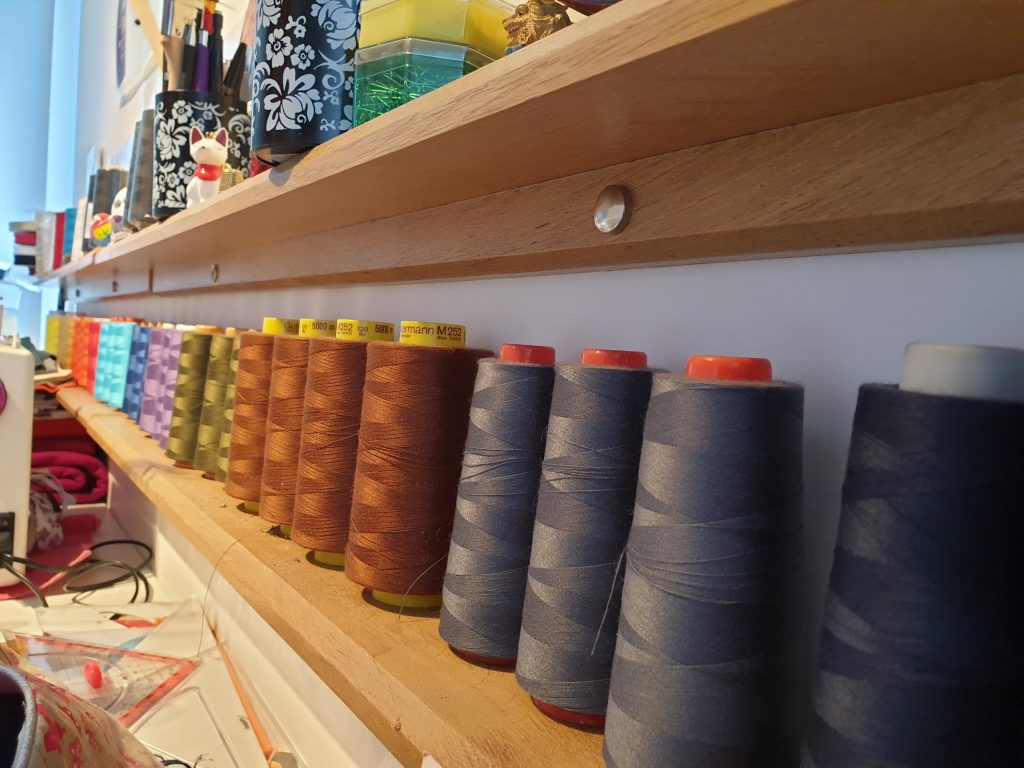

The first sign you’ll see on the spool is its brand.
There are many brands of thread, some good quality and some less so.
Among the well-distributed good brands are: Gütermann, Coats duet, Mettler...
Never compromise on quality. If the thread isn’t smooth or is fuzzy, really, just walk away.
It can be tempting to buy sets of spools at big-box stores at unbeatable prices, but the joy of that saving will be short-lived given the poor quality of such assortments.
The second important sign to look for is the length of the spool.
Warning! You may find markings in meters but also in yards.
For classic colors, I encourage you to choose large spools that you can reuse from project to project.You can even buy 5000m cones of thread in white, black, beige, red, and navy blue... or in the colors you like best. It will be much more economical. For "special" colors, choose a small spool, especially if you’re not sure you’ll sew a garment in that color again.
The only exception is if you have decided to overlock the edges of your garment with a sewing machine and in the color of your base thread. In this case, the overlocking will consume a lot of thread, and it will be necessary to choose a spool of good length.

Third important point to check: the nature of the thread.
Most of the time in haberdashery you will find polyester threads that will suit most of your sewing projects. This is the so-called standard thread that fits the majority of projects.
If you are a beginner, this is the essential purchase.In haberdashery, you can find foam threads, cotton, rayon, silk... which have particular properties.
Fourth important point: the color. Yes, each brand assigns a number to each color. And this is very useful when you need to buy another spool of thread during a project. You will then be sure to buy the same color to continue your work.

Finally, the fifth important point is the thread count, that is to say its size, its thickness.
The higher the thread count, the finer the thread and the more it will be recommended for fine fabrics.
Conversely, the lower the thread count number, the more your thread will be suitable for sewing thick fabrics like woolens.
You now know how to decode the markings on your spools, so it's your turn to play...
