


When I started sewing, I only sewed for myself.
Little by little, my friends began asking me, "Could you make that for me...?" Once I felt confident about the results of my sewing, I wanted to give handmade gifts to family and friends for a new baby, a birthday... or simply make useful clothes for my husband to wear every day: shirts ;-)

A shirt is a complex garment to make, with several technical steps:
- constructing the collar and collar stand
- making the button placket and buttonholes
- attaching cuffs with sleeve openings...
It is therefore a garment to tackle once you have some experience if you want to avoid disappointment, particularly with the finishing.
There are countless shirt designs, with so many variations in collar styles: Italian, English, rounded... and cuff styles: angled, Neapolitan... the possibilities are endless.
To make my shirts, I turned to a wonderful reference book that provides invaluable guidance: "Les chemises" by Ryuichiro Shimazaki. It is published by Editions de Saxe and costs 19.50 euros.

The book contains instructions for making 26 men's designs in 4 sizes (S, M, L and XL).
14 designs are for dress shirts and 12 for casual shirts.
Please note that, as the book is translated from Japanese, the sizing is intended for that audience.
The height range is 1.55 m to 1.95 m. Chest measurements range from 90 to 98 cm, waist measurements from 78 to 86 cm, and neck measurements from 39 to 43.5 cm.
If you or your partner have a larger build, this book may not be suitable unless you know how to grade a pattern to the right size. You can also make a toile if you are unsure about your measurements, or want to test the design before cutting into your good fabric.
All 26 designs are richly illustrated with excellent-quality photographs that help you picture the finished result.
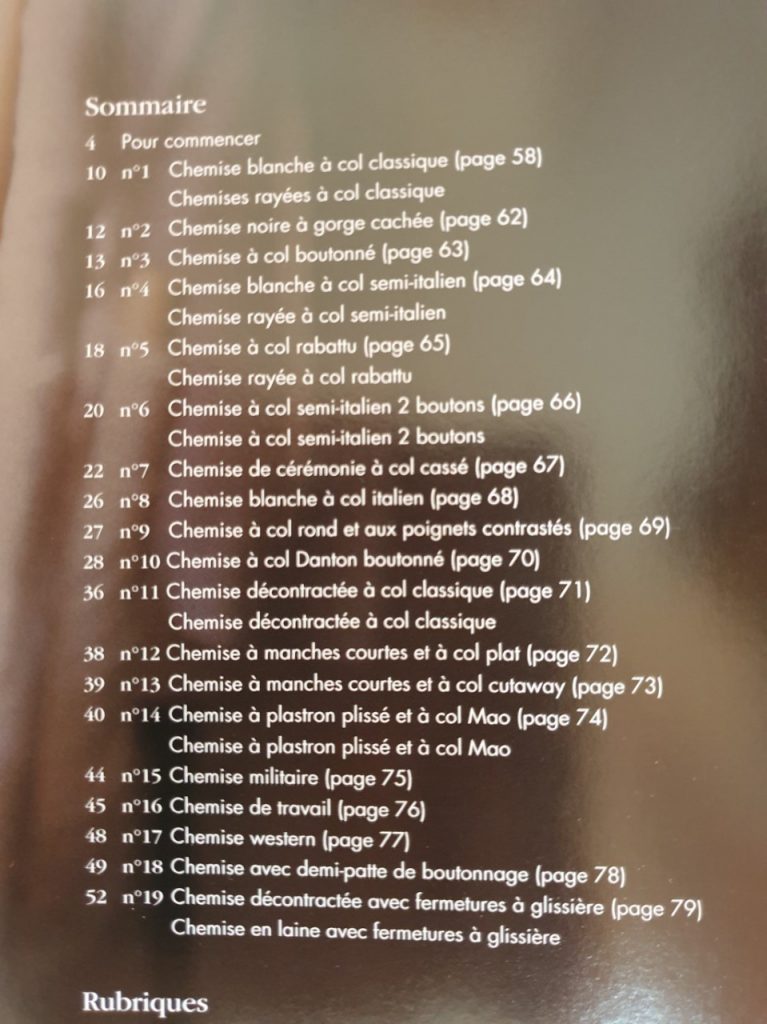 the shirt styles included
Beyond the patterns, you will find a wealth of useful advice from Mr Shimazaki on:
- the history of the shirt and its details
- the history of the collar and its different styles
- cuff styles
- the history of buttons and which types to use
- which fabrics to choose
- care, ironing...
- bleaching and dyeing a shirt
- choosing a shirt and taking measurements.
All this advice proved very useful when making shirts to suit my partner's needs. You need to choose the right collar depending on whether he wants to wear a tie (and then there is the type of knot, but let's not complicate things further), a bow tie or no accessories. Choosing the buttons is also essential if the shirt is to meet the expectations of the person wearing it.
 classic collar - shirt no. 1
 Cuff
Cuff
The 26 patterns are provided on two large, exceptionally detailed pattern sheets, with seam allowances that vary from piece to piece. This can be confusing, as we usually add 1 cm all round. Tracing the first shirt therefore takes time while you work out the allowances. The result is well worth the effort, though, as it allows you to achieve a finish worthy of haute couture.
The construction instructions start with shirt number 1, the classic dress shirt. Every step is described in detail; this is essentially the basic method. You can refer to the clear explanations and drawings. The assembly diagrams are so precise that you could almost manage without the written instructions.
For the other shirt designs, only the steps that differ from the first shirt are detailed. These are also explained and illustrated to make them easy to follow. It is therefore quite straightforward: simply refer to the number of the shirt you want to make.
The pieces are also fairly interchangeable. For example, you can take the cuff from one design and use it on another, giving you plenty of scope to follow your own ideas.


All the fabrics used in the designs shown come from Maison Dorée in Ixelles. There is a lovely selection of excellent-quality fabrics for making shirts. The mustard fabric used for the collar and cuffs comes from a small remnant bought at Créacorner in Woluwé. The wooden buttons were bought at a craft market in Kyoto, Japan. The other buttons were salvaged from old shirts.


Feel free to leave me your comments and share your makes.

1 thought on “My man's shirts according to the book "The Shirts" by Ryuichiro Shimazaki, published by Saxe editions”
Dalhte
Hello !
J’aimerais faire la chemise 12 mais je suis perplexe par rapport au patron du devant (devant B). Avaez vous tenté ce modèle ?