


As the sales season is gradually approaching, I thought it might be useful to guide you through shopping online.
I am an experienced online shopper now, after going through a learning phase. So, to help you avoid the pitfalls of being new to online shopping, I have put together some tips and warnings to help you shop with peace of mind. Let's get started!

The first advantage of the internet: an endless shop window.
Let me explain...
1. The choice is enormous.
You can find everything: colours, textures, drape, materials, stretch...
This saves you visiting or calling every fabric and haberdashery shop in your area to find that fabric you saw on someone's blog, or a jungle-print fabric to make a sweatshirt...
But too much choice can make choosing impossible. If you tend to be indecisive, browsing online will not make things easier, and you may end up wasting time alone in front of your screen.


Before you start searching and shopping, keep the project you want to make and the fabric length you need in mind. This will help you focus your search and set the filters on shopping websites.
3. Buying time versus sewing time
A big advantage of the internet is that it is open 24 hours a day, 7 days a week.
You can shop anytime, anywhere. My speciality is buying fabric on the tram on my way to work; it saves me the time I would otherwise spend travelling to a fabric shop.
Although you can place an order instantly, you will still have to wait for delivery... Depending on where you order from, this can take quite a while: anything from 48 hours to 6 weeks.
Why such a difference?
If you order fabric from reputable, well-established shops, delivery will be quick.
If you buy from an Ebay shop, a less familiar website or Wish... the fabric may be coming from much farther away, such as Vietnam, China and so on.
I have ordered fabric from British Ebay shops myself, and delivery takes about 15 days; for Japanese shops, allow more like 3 to 4 weeks, and often 6 weeks for delivery from China by sea.
This puts the immediacy of online ordering into perspective, especially if you have a deadline for sewing your project.
4. Advice online
When you buy fabric from a good fabric shop, you can benefit from knowledgeable staff and make an informed choice.
Unfortunately, too many online fabric shops still provide poor descriptions of their fabrics. The information is sometimes very limited, or at least incomplete.
So, if you are a beginner and do not want to waste your savings on fabric you will never use (I speak from experience), do your research. These are the right questions to ask before buying fabric:
- What type of fabric does my project need? (weight, stretch...)
- What look do I want? (colour, print, drape and therefore fabric type...)
- How much fabric do I need?
5. Time to think
Take your time when placing an order online. Always check:
- Am I ordering the right fabric for the right project?
- Am I ordering the right length for my chosen project?
There is nothing worse than ordering 1 m of fabric on impulse when the blouse you have been dreaming of needs 1.3 m.

If you want that thinking time when shopping in person, you will have to return the next day or order through the shop's website, if it has one.
6. Photos and colours
Be careful with fabric colours online, as they can look quite different when they arrive. Sometimes a fabric that looks bright in a photo turns out to be duller than you imagined.
Generally, though, this is not a problem, especially if you are sewing a complete garment; the only risk is feeling a little disappointed. So pay attention to the product specifications and the colours described by the seller.
Some websites offer well-chosen fabric combinations, or collections that the designers have already planned to work together.
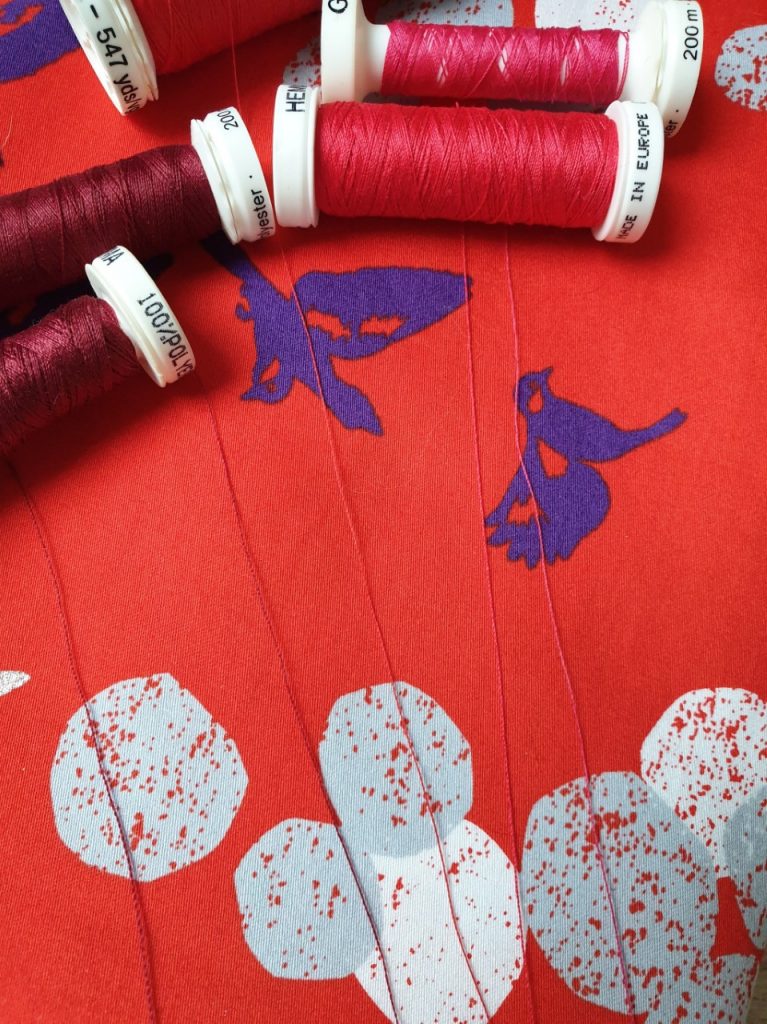 Choosing the thread colour
 Combining shades
6. The experience
The emotional experience of buying fabric will be completely different depending on whether you shop in person or online.
Everyone has experienced that feeling of happiness when leaving a shop with something they have fallen in love with. That is what you will feel when you leave the fabric shop.
Online, the experience is different and often delayed until the parcel arrives... What a joy to unwrap the fabric remnant you ordered, especially when it has been carefully packaged.

It is important to take this aspect into account and know what kind of emotion you want to experience when buying fabric.
Personally, I love buying fabric in fabric shops when I travel. It gives me a souvenir, but it is also about seeking an experience in another country and discovering different emotions.
7. Prices and delivery costs
Finally, the point you have all been waiting for: price. I have deliberately put it at the end of the article, because the points above will give you some clues about what I think.
Average prices online are slightly lower than in fabric shops.
Nevertheless, for all the reasons mentioned above, you will sometimes pay more online than in a shop. Why?
1. Sometimes you do not save money by buying cheap fabric that pills after the first wash because the washing instructions were unclear, or simply because the price was too good to be true and the quality was not there.
2. Delivery
Remember to include delivery costs in your calculations. Depending on where your parcel comes from, you may have to pay customs charges. Delivery costs can also be considerable depending on the parcel's weight, so factor them in.
Another trap is free delivery above a high spending threshold, beyond what you would have spent in a fabric shop.
Some websites offer free delivery if you spend a certain amount, often between 60 and 100 euros. This offer can encourage you to buy more than you actually need, and once again you are no longer saving money at all. That is why we chose a 20-euro threshold for free delivery, as this roughly matches the amount people spend in a fabric shop.
3. Websites that only sell fabric in 50 cm cuts, or even by the metre. This encourages you to buy more and build up a pile of leftover fabric that you may not know what to do with. That is why our shop gives you the option of buying in 10 cm increments.


In conclusion, I think you can happily enjoy both shopping in fabric shops and online, as long as you take a little time to think.
For those taking sewing classes, remember that your teacher is a goldmine of information and can guide you with your purchases.
For experienced sewists and fabric enthusiasts, the magic of the internet gives us a global shop window that opens up so much creativity!
My final tip, especially during the sales: set yourself a budget.
All that remains is to find the right range for you.
