


Some of you have already noticed that besides my passion for sewing, I have another passion which is Japanese culture. This is reflected in the choice of fabrics for my sewing projects.


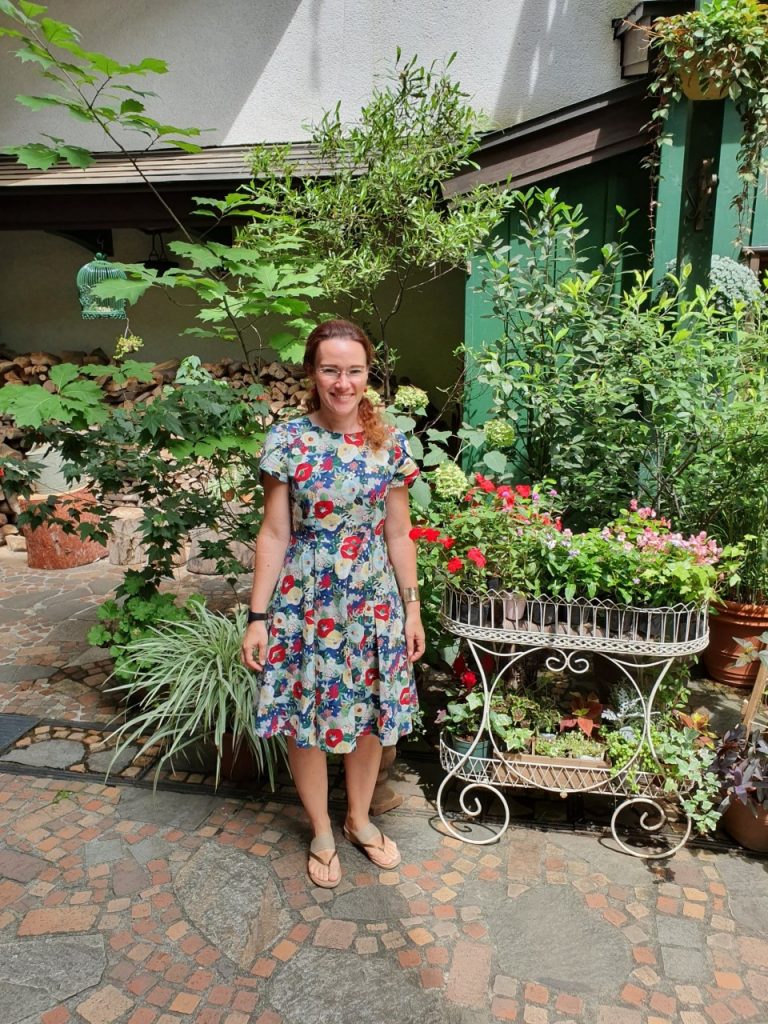
Many of you have asked me where I bought these, and many were disappointed by my answer: in Japan. So, I decided to offer them in my shop, c'est du Joly, feel free to take a look, they are superb.


A lover of Japanese tradition, its rites, its rhythm, and its poetic meanings, I wanted to share with you the significance of the symbols that adorn the magnificent fabrics produced by this beautiful country.
Indeed, while in Europe one might refer to the outdated symbolism of the language of flowers, in Japan, feelings and emotions are depicted in Japanese fabrics, whether noble for kimonos or simple lightweight weaves for a summer yukata; the choice of fabric and pattern is governed by the message one wants to convey.
Thus, in Japan, a bride will wear a richly decorated red kimono for her wedding photos. We can also wear fabric adorned with dragonflies to symbolize strength and courage. The dragonfly was, in fact, worn by many samurai.


I invite you to take a look at some of the symbols you will find in the fabrics selected for my shop c'est du joly!
Let's start with the most well-known motif: the cherry blossom called Sakura in Japanese.
It symbolizes spring and renewal. They also symbolize the fleeting nature of existence, blooming in the morning and withering by evening, a majestic tribute to the cycle of life.
It is also used in metaphors alluding to beauty that unfortunately fades with age.
The sakura flower is also found as a symbol of the Japanese government for over 1300 years. It was painted on the planes of kamikaze pilots sacrificing their lives and falling for the homeland like cherry blossoms fall.
Today, cherry trees are offered as a symbol of peace and sympathy with the various countries with which Japan wishes to strengthen its ties.
It is also the most popular pattern, on children's kimonos or those for adults.


Let’s talk about another flower dear to the Land of the Rising Sun: the peony called botan in Japanese.
The peony, considered the queen of flowers, calls for happiness and fortune.
The peony also symbolizes the feminine ideal, evoking, by its nature as a strong flower blooming in winter, independence, strength of spirit, and kindness.
This pattern, beyond appearing in Japanese fabrics, is also found in tattoo designs for both women and men.


We can’t talk about Japanese patterns without telling you about the crane called tsuru in Japanese, which is very often found as a main or subtle motif in Japanese fabrics. You will also find it present in my red dress above.
The crane symbolizes longevity. Legend has it that a crane lives 1,000 years and inhabits the land of immortals. It is therefore a good omen for living a long and healthy life. It is also invoked by the sick. Who hasn’t heard that folding 1,000 origami cranes can grant a wish?
The crane also became a symbol of peace after the events in Hiroshima and when Sadako Sasaki, a young girl with leukemia, folded more than 1,000 cranes while wishing to get well.


The fan called sensu in Japanese is often found as a motif in Japanese fabric. It is a symbol of happiness and prosperity. Its ribs evoke extension to infinity but also the blooming of a flower through the movement needed to open it.
It is often found as a pattern accompanying summer flowers.


After talking to you about fans, I can’t skip the Seigaiha pattern, which is an ancient Japanese motif. Originally used to illustrate seas and oceans on maps, this pattern appeared in Japan in the 6th century. This wave pattern is used repeatedly in Japanese culture: on textiles, in arts, illustrations, and Japanese gardens. Literally, “Seigaiha” means “blue sea and waves.”
This pattern represents stylized waves on the high seas shaped like fans. Its name comes from the ancient court dance gagaku called Seigaiha, in which dancers wear costumes adorned with this pattern. In the novel The Tale of Genji, the masterpiece of Japanese literature, there is a scene where the hero Genji dances the Seigaiha.


It is also the pretty pattern that decorates my skirt, which I was wearing while unpacking my fabric order with a smile on my face. I hope you will like them.


