


When starting a new creative hobby, you want to buy the necessary materials to start your learning well. In sewing, the choice of materials is immense and so varied that it is sometimes difficult to determine what is really necessary and what is just a gadget.
I invite you to discover my selection of essentials that make up the beginner's kit for the apprentice dressmaker.
Let's start with the tool I prefer so much that I made it my logo: scissors!
You will choose at least 3 pairs of scissors to start:
- tailor's scissors
- embroidery scissors
- paper / office scissors
and if desired, secondly, you can also buy a thread cutter.
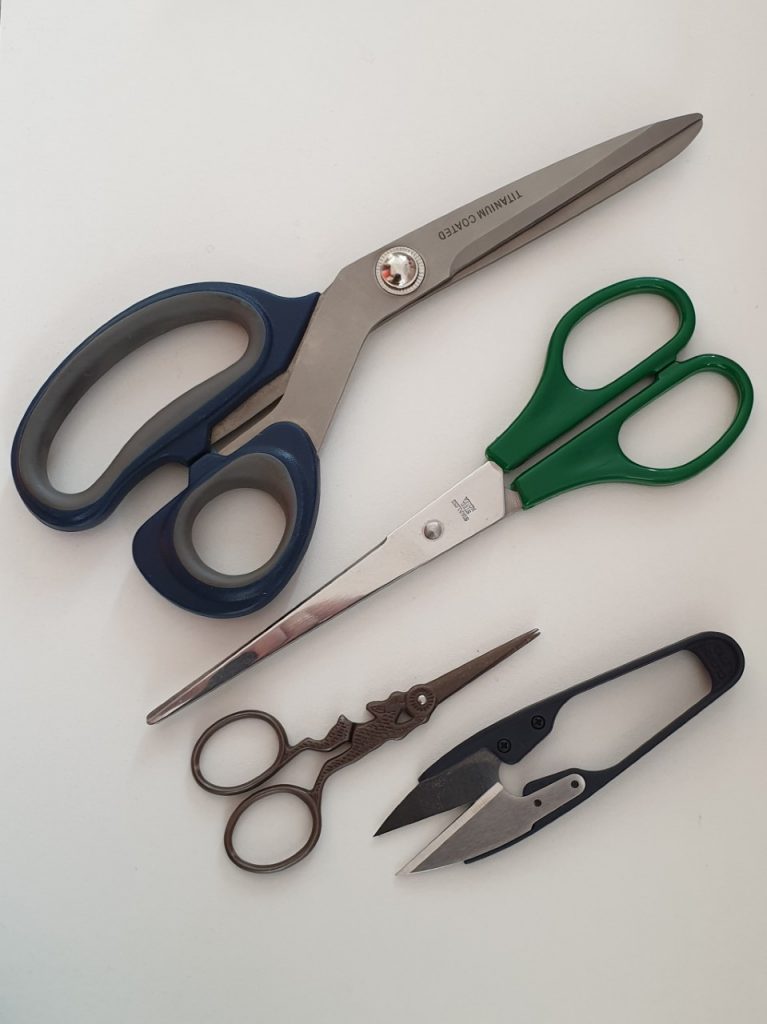 From top to bottom: tailor's scissors, paper scissors, embroidery scissors, and thread cutter
For the tailor's scissors, I advise investing in a good quality pair with well-sharpened blades. Expect to pay at least 15-20 euros for your first purchase. Choose a pair at least 20cm long, which will make cutting large pieces of fabric easier.
For the embroidery scissors, I recommend choosing small scissors with sharp blades whose loops fit your fingers well. This pair will be used to cut small threads, mark your notches, trim seams, and possibly open a buttonhole...
Some pairs are decorated or use animal patterns. Everyone has already seen the famous golden bird pattern; expect to pay around 10 euros for this type of scissors.
The pair for paper can be bought cheaply. You can recycle your office scissors, that will be perfect.
It is strictly forbidden to cut anything other than fabric with tailor's and embroidery scissors because you will damage the blades. They will become dull and will never cut fabric as well again. If you have children, keep these two pairs out of their reach ;-)
Let's move on to the measuring tools.
I will remember several:
- The measuring tape
- The Aristo square or a Japanese stick
- a large ruler or stick at least 30cm long
and secondly a gun
 Various measuring tools: ruler, gun, measuring tape, square...
The measuring tape will help you take measurements. Indeed, to determine your size, you will need to take your measurements. Most of the time, you will have three measurements to take: bust, waist, and hip circumference. Based on your measurements, you can refer to the size chart provided with the pattern and determine the size you will copy.
The set square and/or the Japanese ruler will allow you to copy your patterns and add seam allowances thanks to their gradation.
The large ruler will allow you to draw long straight lines.
Finally, the tracing wheel is a very handy tool to copy the curves of the patterns.
I use a mechanical pencil to trace my patterns onto tracing paper that I buy in 10m rolls for just under 3 euros.
After tracing your pattern, you will need to pin your pieces onto the fabric.
For the pins, start by buying basic pins made entirely of metal, preferably medium size (neither extra fine nor too thick). Decorative needles are tempting but they are not practical for beginners.
A box of good size is recommended and I advise you to buy a pin magnet.
For my part, I have 2 and I couldn't do without them anymore. This tool allows you to gather pins and especially not lose them. The worst that can happen is when you spill your pin box... with the magnet, that's a thing of the past.

After cutting your pieces, you will sew with good thread. Don't skimp on the thread. Good quality thread is a good investment and will be necessary to sew a garment that no one will guess is handmade. Good quality thread will not pill, will not break easily, and will not damage your machine's mechanism. To start, you can buy basic colors like white, black, beige, navy blue, and red. This will already allow you to match your threads well with the fabrics of your first creations. Some haberdashery brands offer starter kits, you can buy these which allow you to make a small saving.
 Example of a kit
You will also need basting thread and needles.
Basting thread is a thread used to temporarily hold pieces of fabric together so they don't move during machine sewing. The basting thread will then be removed after machine sewing. This thread breaks easily, it is quite fragile, which is normal. You will find large white spools, or smaller models in white, light blue, yellow, or red. The goal is for it to contrast with your fabric so it can be spotted and removed once the operation is done.
For the needles, I recommend buying small kits that include several lengths and thicknesses of needles. This will allow you to discover which ones suit you best.
And then, when you make a mistake, you will need a seam ripper.
This one is a kind of small knife that allows you to undo seams quickly and well.
Above all, never use your scissors to open seams, you might cut your fabric irreparably.
Be careful, despite its size, the seam ripper is very sharp/pointed. So be careful when handling it.
This tool will also be useful later to open buttonholes.
 Tracing tool and seam ripper
Depending on your projects, you will need to use tracing tools.
Several are available, the best known is the classic tailor's chalk but I find it inconvenient to use.
I prefer to use a chalk mechanical pencil with a white or colored lead depending on the color of the fabric I need to mark.
The drawback of this one is that the line is thick and when it falls, the lead breaks.
There are also heat-erasable or washable pens. I advise you to test them on the fabric of your project to judge if the mark disappears well because sometimes the pens leave traces.
Finally, invest in a good iron if you don't have one. It is mandatory to have an iron nearby when sewing:
- to iron the fabric
- open seams
- mark folds and hems
- ....
It is essential, really.
Last but not least, the sewing machine! If you are starting sewing alone, you will need to buy a machine. I advise you to buy a basic model or even a second-hand one that will allow you to get started and then invest in the machine that suits your needs. Another option might be to ask to borrow one; there are often some unused in families: a mom, a grandmother, or a godmother might be happy to please you. And for those who will start with a teacher and have no one to borrow from, be patient and wait 6 months of courses, this will allow you to test and choose the sewing machine of your dreams with full knowledge.
 My first machine that allowed me to get started and learn
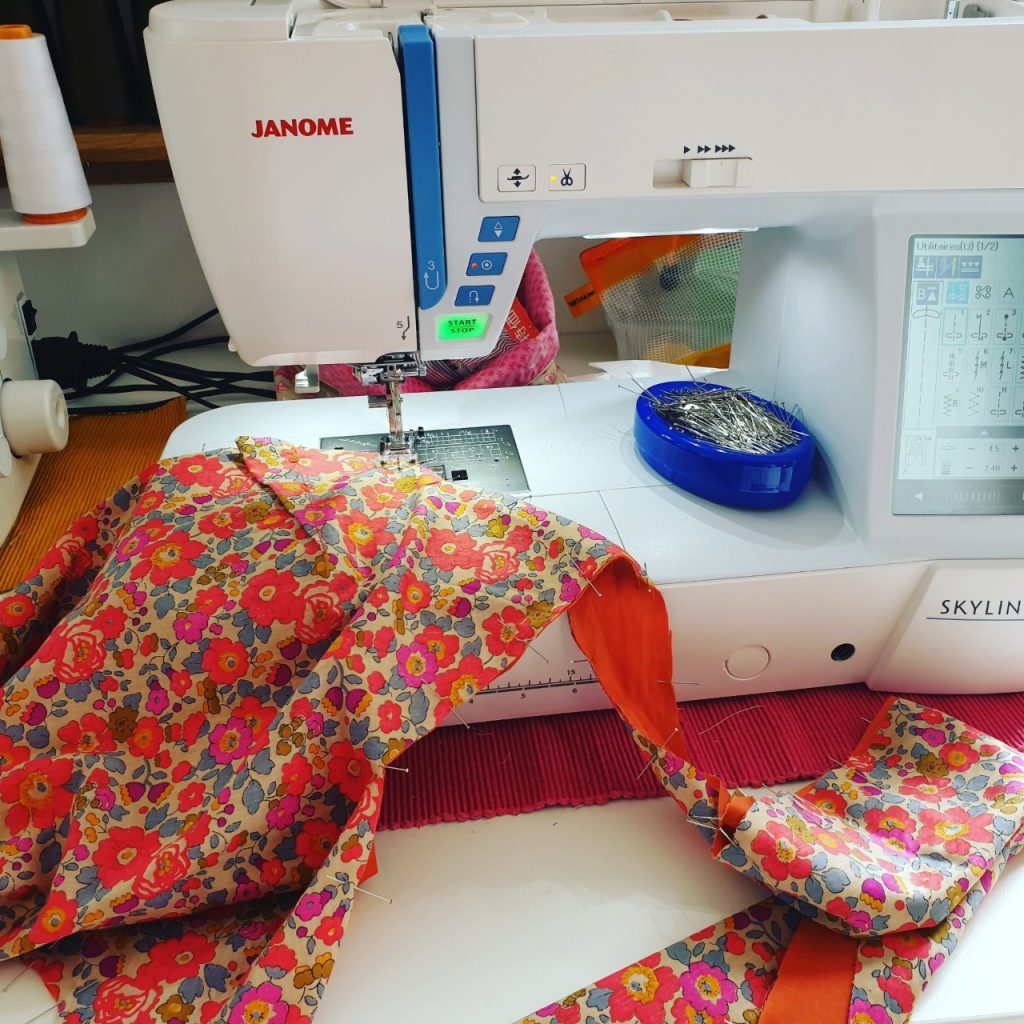 The sewing machine of my dreams ;-)
I have prepared for you The shopping list reminder:
- paper scissors
- tailor's scissors
- embroidery scissors
- roll of paper
- ruler
- square ruler
- measuring tape
- a box of pins and its magnet
- spools of thread
- basting threads
- needle kit
- seam ripper
- tracing tool according to your needs
- an iron if needed
- a sewing machine if needed
Don't hesitate to tell me if this helped you, and to share your tips in the comments.
