


The choice of sewing thread is crucial. Indeed, the thread ensures the garment's strength as well as the quality of its finishes. What a disappointment to see a garment sewn with care tear during the first fitting or the seams come undone after the first wash!
The choice of thread is therefore as important as the choice of fabric.
A good quality thread is smooth and even. If the thread "fuzzes," it means it is of poor quality.
I suggest we examine sewing threads through 5 criteria generally used to classify them.

Let's start with the simplest and easiest criterion to approach: colour.
Choosing the right thread colour is quite simple... or is it?
If your fabric is plain:
Choose, from the shop's thread colour chart, the spools whose colours most closely match your fabric's colour. Lay the thread (not the whole spool, just unwind a bit) on your fabric, squint your eyes, and choose the thread shade you no longer perceive once your eyes are squinted. If you hesitate between two colours, I advise you to take the darker one.
If your fabric contains several colours:
Choose to match your thread to the dominant or the darkest colour.
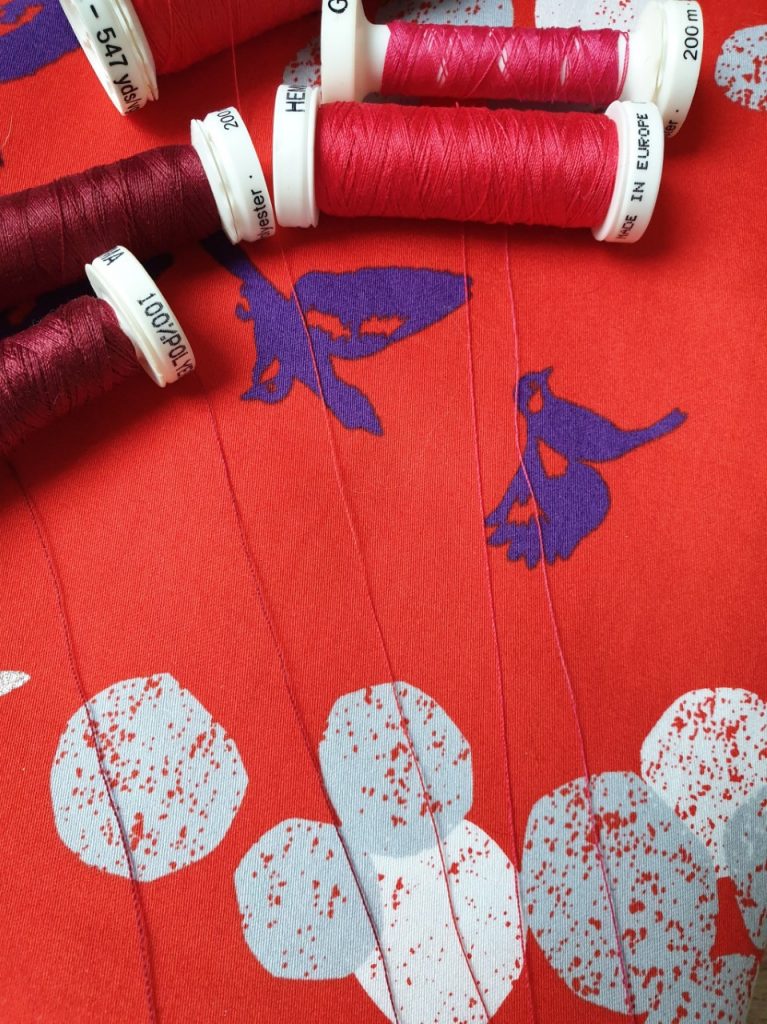
Finally, you still have the option, if you wish, to use a contrasting thread to highlight the seams. This is what is done for seams on denim or to create decorative seams, for example with metallic thread. It should be noted that when we decide to make visible contrasting seams, precision is necessary because all mistakes will be visible.
Let's move on to the thickness of the thread, which will give it its strength.
The thickness of the thread is called the thread count.
The thread thickness is indicated on the spool by a number generally between 30 and 120. This number is called the metric number and corresponds to the number of kilometres of thread contained in one kilogram of thread.
For a metric number of 100, there are therefore 100 km of thread in 1 kg of this type of thread.

So, the higher the number, the finer the thread; conversely, the lower the number, the thicker the thread.
To choose the right thread count, you must know the thickness of your fabric; the thicker the fabric, the thicker and stronger the thread must be.

The material of the thread will be chosen according to the intended use.
Indeed, the thread's material will give it more or less stretch.
Polyester thread is the most used and sold. It has many qualities and suits the majority of sewing projects. It is strong. It resists abrasion, mildew, and sunlight.
Moreover, it is stable and does not shrink.
Finally, it is slightly stretchy, which allows its use for knit fabrics.
Polyester thread number 100 is called the universal sewing thread and suits 90% of sewing uses, so it is often the main purchase.
Cotton thread is a natural option worth considering for woven fabrics. It should not be used for knits and stretch fabrics in general because cotton thread has no stretch.
We will note that this thread can be used for sewing natural woven fabrics and is rather fine.
Basting thread is a thick and soft thread that breaks easily. It is used to hold fabric pieces together (temporary seams) before the final assembly. Then, this thread is removed. Note that on fine fabrics or fabrics that mark (leather, canvas...), it should be avoided because it will leave "holes" in the fabric. It is better to use clips to stabilize these fabrics during assembly.
Elastic thread is a stretch thread that we favour for sewing garments that must be stretchy and durable, notably swimwear. It will therefore be preferred for lycra and jersey pieces.
It is a thread soft on the skin, so it is perfectly suited for lingerie or baby clothes.

There are still many other types of thread such as rayon thread, silk thread, polycotton thread... limited to very specific uses that I will not detail here.
I hope this article will help you choose your thread better according to your project.
Do not hesitate to leave me a comment if you liked this article and it helped you see things more clearly.
